Swim Meet 101
If you and your swimmer are new to swim meets, this is the page for you! We hope it provides answers and guidance for what to expect, what to pack and how a meet operates. Please be sure to contact us if you have additional questions. We have all been first time swim families and want to help you!


What to Pack
- A highlighter for finding and marking your child's events on the heat sheet.
- A Sharpie for marking your child's arm (see separate info re: marking your child)
- Healthy snacks: granola bars, fruit, water, Gatorade, crackers. Coolers are allowed, however, concessions are sold at each meet for your convenience as well.
- Extra towels
- Camp chairs or a picnic blanket
- Pop-up tents or umbrella tents, where space allows. Shade is key on hot evenings!
- Sunscreen
- Swim cap and goggles (a spare pair of goggles is a good idea, too)
- Cash for the concession stand
How Meets Operate
Meets are typically on Tuesdays & Thursday evenings, with the meet beginning around 6pm. Home team warm-ups usually start at 5:00 (in the water at 5:00) with a 4:45 arrival time. Away teams warm up after the home team.
Pre-Meet Preparation:
- The Coach will inform swimmers of the events they are swimming in on or before the day of a meet. You will be responsible for logging in and signing your child up to confirm they will be at the meet!
- Directions to away meets may be found under Meets & Events.
Arriving at the Meet:
- Get to the pool on time. Allow extra time for parking and walking to the pool.
- Check-in with the Coaches to let them know you are there.
- At some meets you may purchase a Heat Sheet that lists the names of swimmers and the event in which they’re entered for the meet, conference qualifying times, and the fastest time for your child to-date.
- Parents check-in with Volunteer Coordinator.
Number of Events per Swimmer
Dual meets: Each swimmer is allowed to swim up to three individual events [the four strokes and, for 9 and up, the Individual Medley (IM)]. Coaches may place swimmers in up to two relays.
Invitationals: Invitationals vary in format and each team will determine the number of individual events and relays that area allowed per swimmer.
Strokes and Events
The four competitive strokes are:
- Freestyle is characterized by an alternate overhand motion of the arms and an alternating up and down flutter kick.
- Backstroke consists of an alternating motion of the arm while on the back using a flutter kick.
- Breaststroke requires simultaneous movements of the arms on the same horizontal plane. The hands are pulled from the breast in a heart-shaped pattern and recovered under the surface of the water except at the finish. The kick is a simultaneous somewhat circular motion similar to the action of a frog. On turns and at the finish, the swimmer must touch with both hands.
- Butterfly consists of a simultaneous overhand stroke of the arms combined with an undulating dolphin kick. In the kick, the swimmer must keep both legs together and may NOT use any other kick. On turns and at the finish, the swimmer must touch with both hands.
The following events are in addition to the above strokes:
- Individual Medley (I.M.) features all four strokes. The swimmer begins with the butterfly, then changes to the backstroke, then breaststroke, and finally freestyle. This event is only for swimmers ages 9 and older. Some swimmers remember this with the saying "Butter your Back so your Breast is Free!"
- Medley Relay consists of 4 team members swimming one leg each of the four strokes. The first swimmer swims the backstroke, the second swimmer swims breaststroke, third swimmer swims butterfly and the last swimmer swims freestyle. An easy way to remember these is that they are in alphabetical order!
- Freestyle Relay consists of 4 team members swimming freestyle for each leg.
Most young swimmers start out swimming freestyle and backstroke before progressing to breaststroke and butterfly. It is not essential to know all strokes before joining the team. Strokes will continue to be taught and improved upon during practice.
Ribbons
Kids love ribbons! Ribbons are awarded for a 1st-6th place in each event and are generally ready the next day at practice. Invitationals sometimes offer medals or trophies for 1st-3rd place finishes.
Heats
What is a heat?
It is a swimmer’s placement in an event based on time, allowing swimmers of comparable skill levels to compete against each other. There may be multiple heats per event. Some events will award heat tags or prizes for the winner of a heat. The winner of a heat is not necessarily the winner of the event.
What is an event?
It is the age group, length and type of stroke or relay to be swum.
Heat Sheets
The Heat Sheet is a paper packet/program that shows all the participating swimmers and what events they will participate in, as well as the heat number and lane number. Heat Sheets will be available on Swimtopia for home meets. It is advisable to print the heat sheets and bring them to the meet so you can follow along with the progression of the meet! Heat sheets may also be available in a printed format at some meets for purchase for a small fee.
The announcer will say the event and the heat number. Sometimes there is also an electronic board with this information.
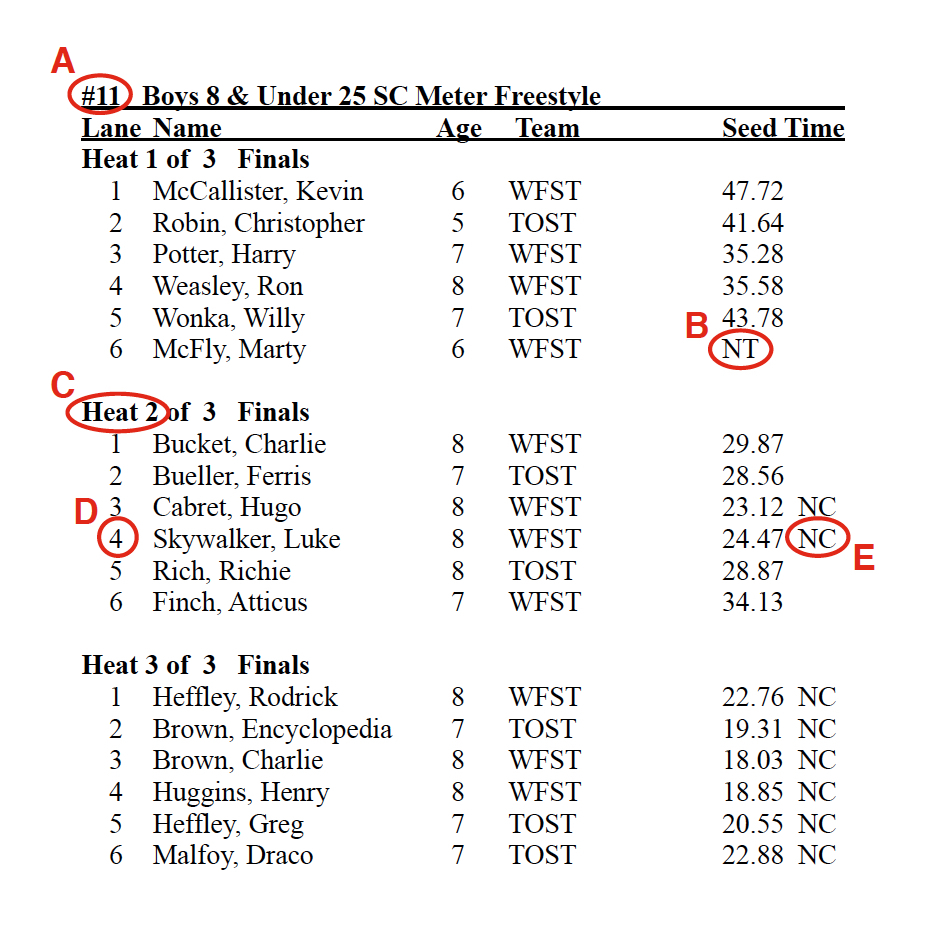
Pictured below is an example of a Heat Sheet.
This Heat Sheet example shows the entries from two teams for the Boys 8 & Under 25 Meter Freestyle.
Seed Time is the fastest time a swimmer has swum an event.
A: The event number
B: NT means "No Time" has been recorded previously
C: The Heat number
D: The lane number
E: Conference swim meet qualifying time
How to mark your child
This is one of those crazy but genious swim team culture things that you will get used to!
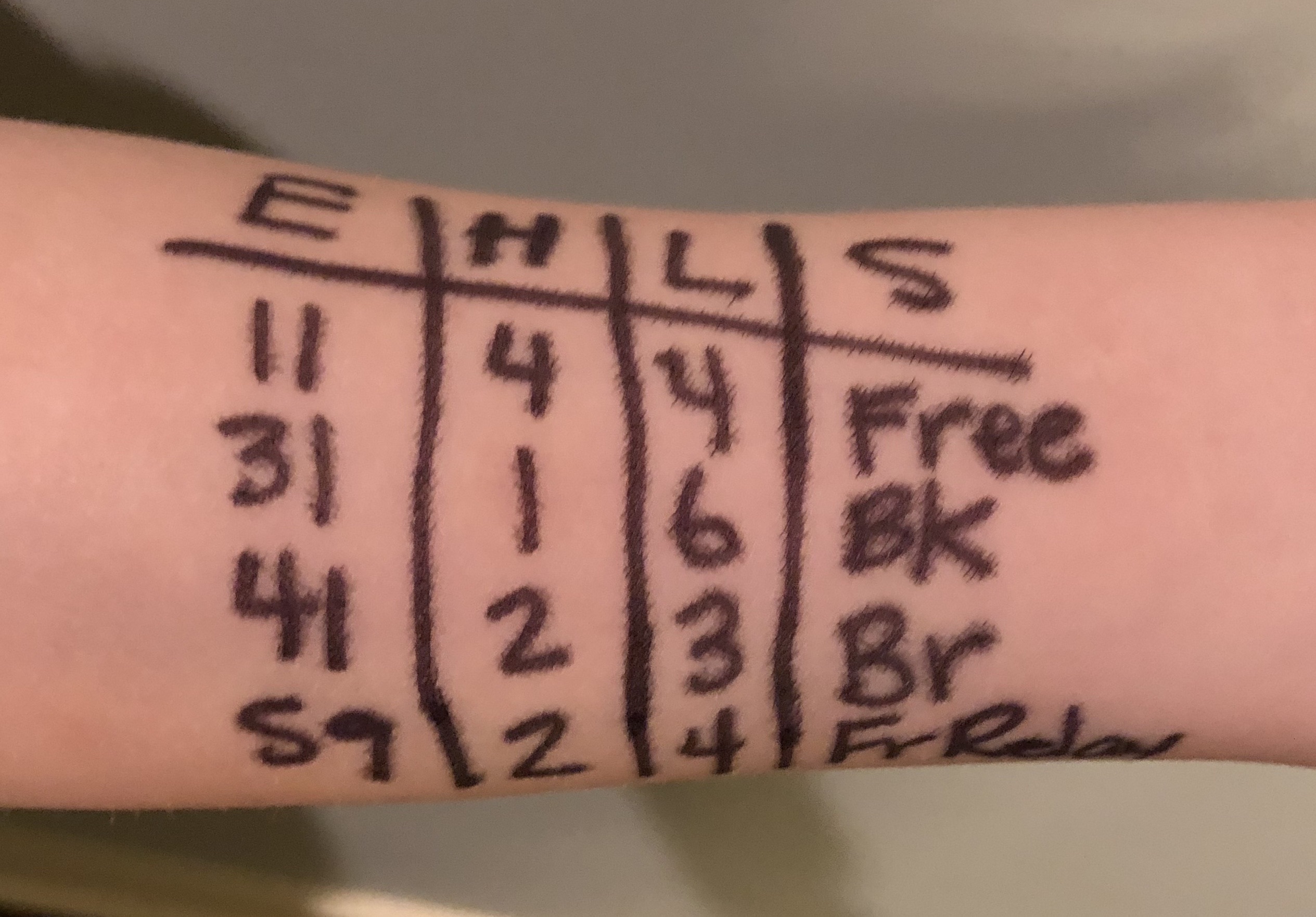
To help you and your child keep track of their specific events at the meet, most families mark the events on the child similar to the example below. First, highlight all places in the Heat Sheet where your child's name is found. Then, use that Event, Heat, and Lane information to create a grid/list on your child's arm in permanent marker.
Make four (4) column headings - E, H, L, S. These stand for Event, Heat, Lane and Stroke. Go through the heat sheet and find your swimmer's name which you highlighted. For each event, write the event number, heat number, lane number and stroke in the corresponding column.
Note: For younger swimmers, write your swimmer's name in big letters on his/her arm or back. This helps the volunteers who are lining up the swimmers at the starting blocks.
In this example, the child is swimming:
Event #11, Heat 4, Lane 4, 25M Freestyle
Event #31, Heat 1, Lane 6, 25M Backstroke
Event #41, Heat 2, Lane 3, 25M Breaststroke
Event #59, Heat 2, Lane 4, Free Relay
Each swimmer is responsible for their own event schedule. Listen carefully as the events are called so that you do not miss your event.
At the conclusion of the meet, the Sharpie can be removed with alcohol-containing hairspray, hand sanitizer or rubbing alcohol.
Getting disqualified
You will see “officials” on the pool deck to make sure we are following USA Swimming rules and that our swimmers are competing with legal strokes.
Occasionally, a judge will disqualify (or "DQ") a swimmer during their event. Below is a list of common reasons a swimmer is disqualified.
Freestyle: Pulling on the lane line; pushing off from the bottom of the pool
Breaststroke: Improper kick; arm pull below the hips; failure to perform two-handed touch at turn or finish
Butterfly: Flutter kick instead of dolphin kick (swimmer must keep both legs together); failure to perform two-handed touch at turn or finish
Backstroke: Rolling over to stomach as the swimmer touches the wall; improper flip turn
Relays: Leaving the starting block too soon
Once a swimmer gets disqualified, they are not eligible to place in that event no matter what their time is.
Every swimmer has been DQ'd at one point or another! Please reassure your swimmer that it is okay and that you are proud of them. The coaches will have tips for them to improve and will go over these with the swimmer in practice.
Diving into the pool
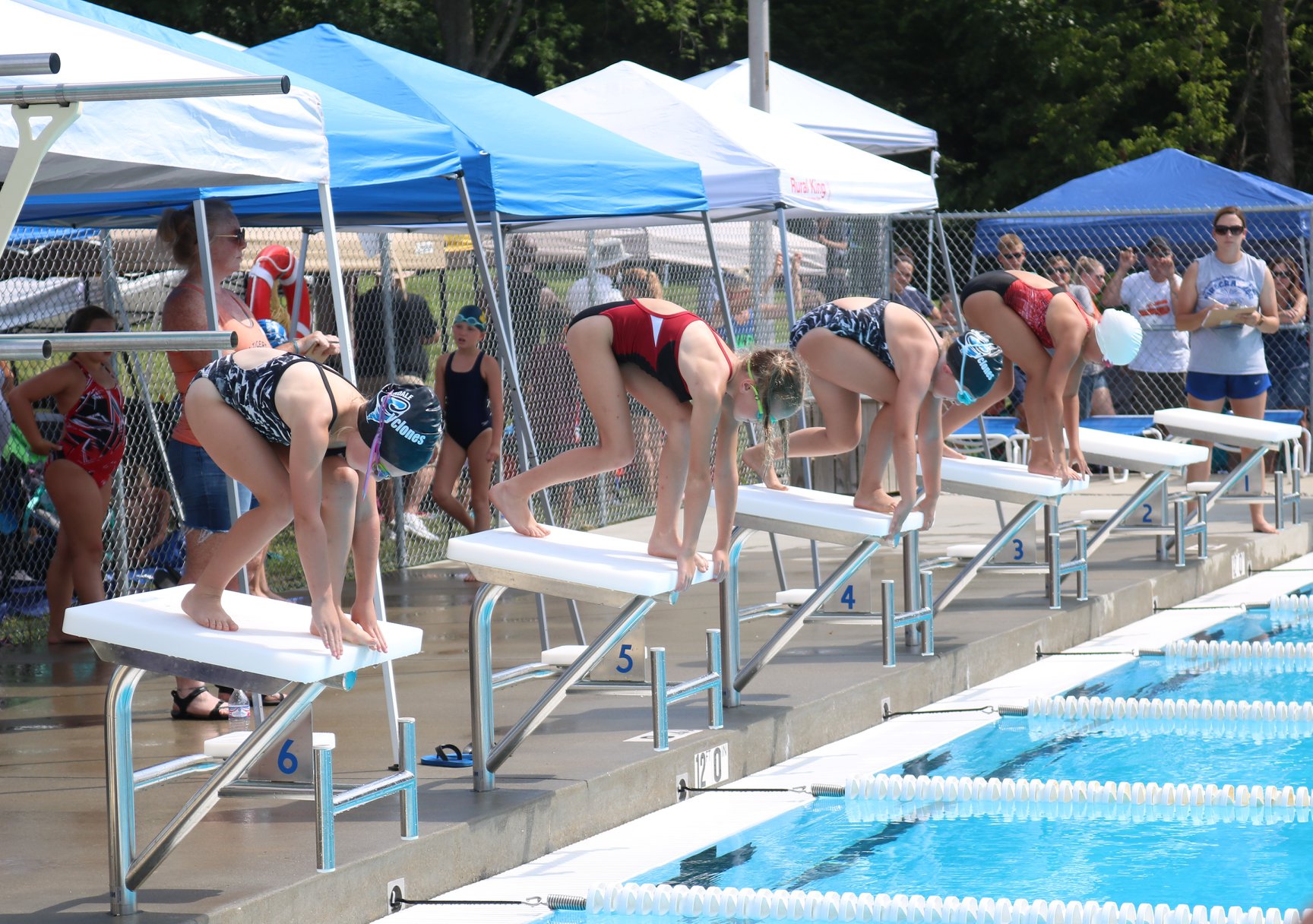
During practices, your child will receive instruction on diving off a starting block. If they are unable to do this, they are permitted to dive off the side of the pool. A swimmer is also allowed to be in the water and push off the side of the wall to begin the event.
What’s My Time?
Swimmers will learn to ask for their time from the timer when they get out of the pool at the end of their race. The swimmer can find out their official time once the results are posted for that particular event.
Championship Swim Meet
Swimmers who compete in at least three meets and hold one of the top 2-3 times in a stroke in their age group in an event will earn a place at the Championship meet. Your coach will notify your child if he/she qualifies!
Downloadable Guides
Tips for New Summer Swim Families
Guide to Swim Lingo